Alaska Palm Trees
You might be surprised to learn that palm trees can indeed thrive in the state of Alaska. While many assume that Alaska’s summer temperatures are consistently cool, the truth is that the state experiences all four seasons.
Summers can see temperatures soaring into the 90s°F, while winter temperatures plummet below an astonishing -60°F (-52°C).
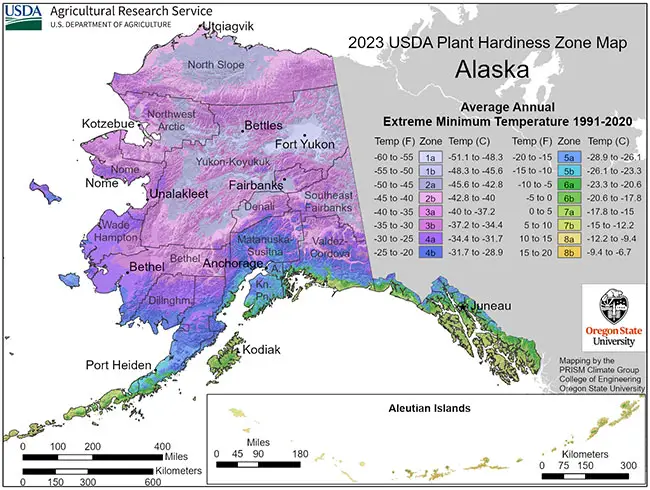
Given the extreme temperature range, Alaska’s climate spans a wide spectrum, ranging from USDA Zone 1a to 8b. The state can be divided into five major zones: Southeast, South, West, Interior, and North, each offering a unique climate.
Southeast
The climate in Juneau and the southeast panhandle resembles a milder version of Seattle. It stands as the warmest and wettest part of Alaska. Winters are relatively moist and lengthy but only mildly cold, with January temperatures dropping to around 20°F (-6.7°C). Spring, summer, and fall are cool to mild, with July highs peaking at 65°F (18.3°C).
South
Southcentral Alaska enjoys a mild climate with temperatures ranging from an average high of 65°F in July to an average low of 10°F in December. The region experiences short, cool summers and frequent strong southeast winds.
West
Despite its northern location, the West has a moderately temperate climate, characterized by a significant variety, particularly in terms of precipitation.
Interior
The interior of Alaska boasts an extreme subarctic climate. Summers can see temperatures soaring into the 90s°F (around 34°C), while winters are exceptionally cold, with temperatures plunging below -60°F (-52°C).
North
This region features an Arctic climate, with long, frigid winters and short, cool summers. Even in July, the average low temperature in Barrow hovers just above freezing, at 34°F (1°C).
Growing Palm Trees in Alaska
Given Alaska’s diverse climate, spanning USDA Zone 1a to 8b, there are indeed some remarkably hardy palm varieties that can not only survive but thrive in the state.
One such palm is the Needle Palm Tree, capable of enduring cold temperatures down to -10°F when mature. In fact, it’s possible to successfully grow Needle Palm in Zone 5 within Alaska.
Absolutely, when cultivating palm trees in colder zones, providing them with proper cold protection is essential. Even the most cold-hardy palm varieties can be vulnerable to severe winter conditions. It takes just one harsh winter to potentially harm or even kill these resilient plants.
Implementing protective measures, such as wrapping the palm or creating a microclimate, can significantly improve their chances of surviving and thriving in colder climates. Some other cold hardy palms that can be grown in Zone 7 are:
- European Fan Palm Tree – Zones 7b – 11 (5 to 10 F)
- Pindo Palm Tree – Zones 7b – 11 (5 to 10 F)
- Sago Palm Tree – Zones 7b – 11 (5 to 10 F)
- Saw Palmetto Palm Tree – Zones 7a – 11 (0 to 5 F)
- Windmill Palm Tree – Zones 7b – 11 (5 to 10 F)
More Palm Trees»
Major Cities in Alaska
Anchorage – Hardiness Zone 4b
Fairbanks – Hardiness Zone 2a
Juneau – Hardiness Zone 7a