South Dakota Palm Trees

South Dakota’s climate is far from suitable for growing palm trees due to its extreme cold. The state boasts a continental climate marked by hot semi-humid summers and bitterly cold winters.

Average July temperatures typically span from 74°F to 80°F (23°C to 26°C), while January brings frigid temperatures ranging from 15°F to 25°F (-9°C to -3°C). South Dakota contends with around 30 tornadoes annually, and during the winter months, it is prone to blizzards and ice storms.

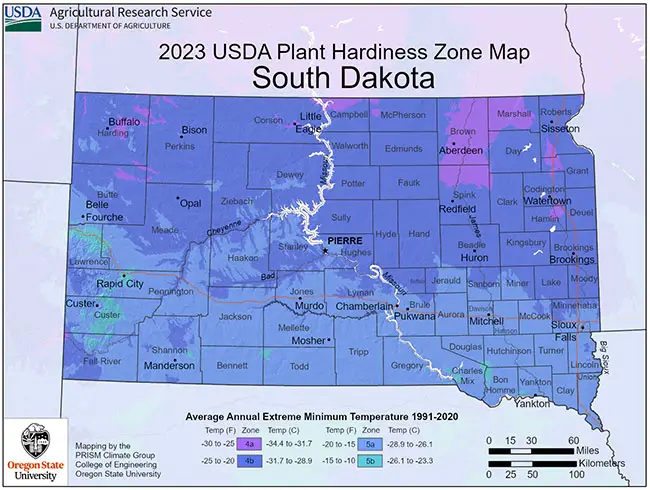
Temperature extremes are a notable feature of South Dakota’s climate, with the highest ever recorded temperature reaching a scorching 120°F (49°C) and the lowest plummeting to a staggering -58°F (-50°C). The USDA hardiness zones in South Dakota range from 3b to 5b.

Growing Palm Trees in South Dakota

This state is way too cold for palm trees. The only way you can have palm trees is if you grow them indoors and take them out during warm days. Here are some great indoor palms:

More Palm Trees»

Major Cities in South Dakota

Rapid City – Hardiness Zone 5a
Sioux Falls – Hardiness Zone 4a

Similar Posts

  • Alabama Palm Trees

    Alabama offers a welcoming environment for numerous cold-hardy palm tree varieties. The state enjoys a warm and humid climate heavily influenced by the Gulf of Mexico, classified as humid subtropical. Alabama experiences scorching summers and mild winters. Summer average temperatures hover around 90°F (32°C), while winter temperatures settle at approximately 34°F (1°C). The southern part…

  • Indiana Palm Trees

    Indiana’s climate isn’t favorable to palm tree cultivation. The state experiences a humid continental climate, characterized by chilly winters and warm summers. In January, temperatures typically range from 17°F (–8°C) to 35°F (2°C), while July sees averages ranging from 63°F (17°C) to 88°F (31°C). The USDA hardiness zones in Indiana span from 5b to 6b….

  • Massachusetts Palm Trees

    Cultivating palm trees in Massachusetts is a challenging endeavor, primarily due to the state’s limited zone 7 area and the daunting winter storms it often faces. Massachusetts boasts a continental climate marked by cold, snowy winters and warm, humid summers. In January, average temperatures dip to around 22°F (–6°C), while July ushers in a milder…

  • Arkansas Palm Trees

    Despite Arkansas’ reputation for extreme weather, it is possible to cultivate palm trees in the state. Arkansas boasts a subtropical climate characterized by hot, humid summers and relatively colder, drier winters. Summers see average temperatures in the low 90s, accompanied by high humidity levels, while winters tend to linger in the low 50s. Throughout a…

  • 10 Palm Trees That Grow in Virginia (with Pictures)

    While Virginia may not be the ideal location for palm tree cultivation, there are several cold-hardy palm varieties that can thrive in the state’s unique climate. Virginia experiences a mild, humid coastal climate characterized by hot, humid summers and cold, snowy winters. July typically sees an average temperature of 78°F (26°C), while January’s average temperature…

  • Wyoming Palm Trees

    Wyoming’s climate is too cold to support the growth of palm trees. The state experiences a semi-arid and continental climate, primarily influenced by factors such as its high altitude, northern latitude, and local topography. These elements collectively contribute to temperature fluctuations, precipitation levels, airflow patterns, and humidity levels. Overall, Wyoming is characterized by its dry…