Utah Palm Trees

In Utah, you can successfully cultivate cold-hardy palm trees that exhibit remarkable durability and adaptability to desert conditions.

Utah boasts a semi-arid to arid climate, characterized by pleasant weather featuring warm summers and mild winters. Approximately 33% of the state comprises true desert areas, where winter temperatures typically average below 32°F during the winter months.

In contrast, the average temperature in July reaches around 78°F (26°C), while January’s average temperature hovers at approximately 28°F (–2°C).

Utah receives an annual average of about 59 inches (150 cm) of snowfall. The primary chain of the Rocky Mountains often acts as a protective barrier, shielding Utah from the frigid Arctic air masses moving down from the north.

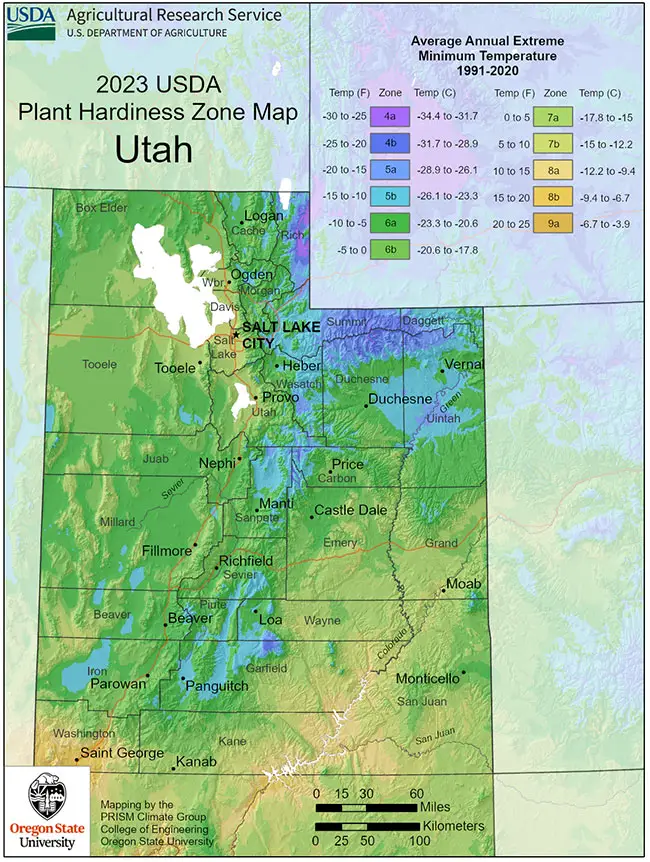
The state’s climate has seen extreme temperature fluctuations, with the highest ever recorded temperature reaching 117°F (47°C) and the lowest plummeting to a chilling -69°F (–56°C). Utah’s USDA hardiness zones span a range from 4a to 9a.

Growing Palm Trees in Utah

Since some of the Utah has desert climate, select palm trees that are durable and will tolerate desert conditions. Here are some of the palm trees that can be grown in Utah:

More Palm Trees»

Major Cities in Utah

Provo – Hardiness Zone 6a
Salt Lake City – Hardiness Zone 8a
Sandy – Hardiness Zone 7a
Similar Posts

  • Indiana Palm Trees

    Indiana’s climate isn’t favorable to palm tree cultivation. The state experiences a humid continental climate, characterized by chilly winters and warm summers. In January, temperatures typically range from 17°F (–8°C) to 35°F (2°C), while July sees averages ranging from 63°F (17°C) to 88°F (31°C). The USDA hardiness zones in Indiana span from 5b to 6b….

  • 10 Palm Trees That Grow in Virginia (with Pictures)

    While Virginia may not be the ideal location for palm tree cultivation, there are several cold-hardy palm varieties that can thrive in the state’s unique climate. Virginia experiences a mild, humid coastal climate characterized by hot, humid summers and cold, snowy winters. July typically sees an average temperature of 78°F (26°C), while January’s average temperature…

  • Tennessee Palm Trees

    Growing palm trees in Tennessee poses a considerable challenge due to its cold winters. The state’s climate varies, encompassing a humid subtropical climate in some areas and a humid continental climate in others. Summers tend to be hot and humid, with average July temperatures hovering around 90°F (32°C). Winters, while generally mild to cool, feature…

  • California Palm Trees

    Growing palm trees in California is a breeze, especially if you’re situated in the warmer regions. California’s climate spans the gamut from arid to subarctic, featuring dry summers and rainy winters. In July, temperatures across the state average between 75°F (24°C) and 93°F (34°C), varying by location. Come January, you can expect average temperatures to…

  • Louisiana Palm Trees

    There are numerous palm tree varieties that thrive in the state of Louisiana, thanks to its accommodating climate. Louisiana boasts a humid subtropical climate heavily influenced by the Gulf of Mexico. Summers are characterized by scorching heat and high humidity, with an average July temperature hovering around 82°F (28°C). Winters, on the other hand, are…

  • Kansas Palm Trees

    Kansas is not conducive to palm tree cultivation due to its predominantly cold climate. The state of Kansas experiences three distinct climate types: humid subtropical, humid continental, and semi-arid steppe. Depending on the region, summers can be either hot and humid or hot and dry, with July maximum temperatures ranging from 91°F (32°C) to 93°F…

One Comment

  1. I would like update information on best palm trees for my area. Currently I shall be moving. May you help select the appropriate palm tree for the area I amean moving too? thank you.

Comments are closed.