Tennessee Palm Trees

Growing palm trees in Tennessee poses a considerable challenge due to its cold winters. The state’s climate varies, encompassing a humid subtropical climate in some areas and a humid continental climate in others.

Summers tend to be hot and humid, with average July temperatures hovering around 90°F (32°C). Winters, while generally mild to cool, feature average January temperatures of approximately 40°F (4°C).

Tennessee experiences around 50 days of thunderstorms each year, occasionally witnessing tornadoes, remnants of tropical cyclones, and ice storms.

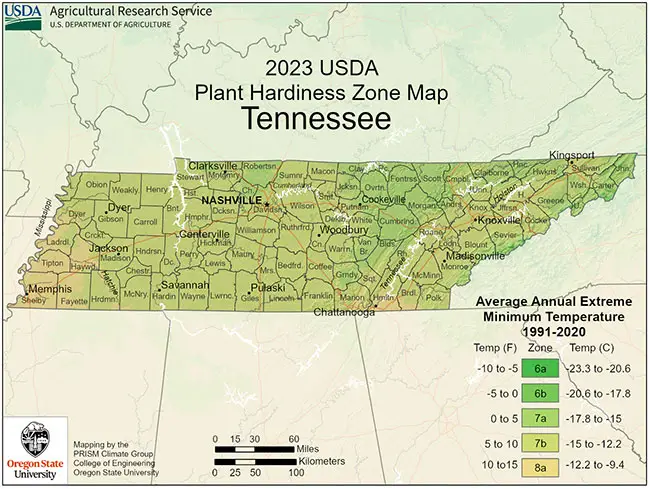
Temperature extremes have been observed in Tennessee, with the highest recorded temperature soaring to 113°F (45°C) and the lowest plummeting to a bone-chilling -32°F (–36°C). The state’s USDA hardiness zones encompass a range from 5b to 8a.

Growing Palm Trees in Tennessee

Growing palm trees in Tennessee is very challenging. If you want to grow palm trees, you need to live in zone 7. If you live in colder areas, you will need to create a microclimate that has at least temperatures of zone 7.

Here are some very cold hardy palm trees that can tolerate cold temperatures done to 5F and colder:

More Palm Trees»

Major Cities in Tennessee

Chattanooga – Hardiness Zone 7a
Clarksville – Hardiness Zone 6a
Jackson – Hardiness Zone 6a
Johnson City – Hardiness Zone 6b
Knoxville – Hardiness Zone 7a
Memphis – Hardiness Zone 7b
Nashville – Hardiness Zone 6b
Similar Posts

  • North Dakota Palm Trees

    North Dakota’s climate is simply too cold to support the growth of palm trees. The state experiences a continental climate characterized by hot summers and cold winters. In January, the average temperature drops to a chilly 7°F (-14°C), while July brings an average temperature of 69°F (21°C). North Dakota is known for its extreme weather,…

  • 10 Palm Trees That Grow in Virginia (with Pictures)

    While Virginia may not be the ideal location for palm tree cultivation, there are several cold-hardy palm varieties that can thrive in the state’s unique climate. Virginia experiences a mild, humid coastal climate characterized by hot, humid summers and cold, snowy winters. July typically sees an average temperature of 78°F (26°C), while January’s average temperature…

  • Illinois Palm Trees

    You can give palm tree growing a shot in zone 7a, especially near the Kentucky border where the climate leans closer to humid subtropical. Illinois, however, is more on the temperate side. Summers here get hot and humid, with average temperatures ranging from 70°F (21°C) to 77°F (25°C), while winters can be cool to downright…

  • Arkansas Palm Trees

    Despite Arkansas’ reputation for extreme weather, it is possible to cultivate palm trees in the state. Arkansas boasts a subtropical climate characterized by hot, humid summers and relatively colder, drier winters. Summers see average temperatures in the low 90s, accompanied by high humidity levels, while winters tend to linger in the low 50s. Throughout a…

  • Connecticut Palm Trees

    While Connecticut may not be the palm tree paradise, there’s still hope for cold-hardy palm enthusiasts in zone 7. Connecticut’s climate is a blend of humid continental and humid subtropical, featuring hot and dry summers with average temperatures ranging from 81°F (27°C) to 87°F (31°C). Winters, on the other hand, can be chilly, with average…

  • Oregon Palm Trees

    Oregon offers some warm areas where cold-hardy palm trees can thrive. The state is divided into several regions with climates ranging from temperate to drier semi-arid, and its weather is significantly influenced by the Pacific Ocean. Average January temperatures span from 25°F (–4°C) to 45°F (7°C), while average July temperatures vary from 5°F (18°C) to…

2 Comments

  1. Lucas A moss says:

    ‘Not sure what your hardiness zone is? Enter your zip code into the box below and click “GO” button.”

    I do not see the box where I need to enter my zip code. Where is it?

  2. barry kohl says:

    my zip code is 37144, looks like zone 7B

Comments are closed.