New Hampshire Palm Trees

New Hampshire is not a suitable place for palm trees due to its cold climate. The state experiences a humid continental climate characterized by cold and snowy winters, as well as warm and humid summers.

In the southeastern part of the state, the influence of the Atlantic Ocean is felt. July sees average temperatures around 70°F (21°C), while January averages around 21°F (–6°C). Annually, New Hampshire receives a significant amount of snowfall, ranging from 60 to 100 inches (150 to 250 cm) across the state.

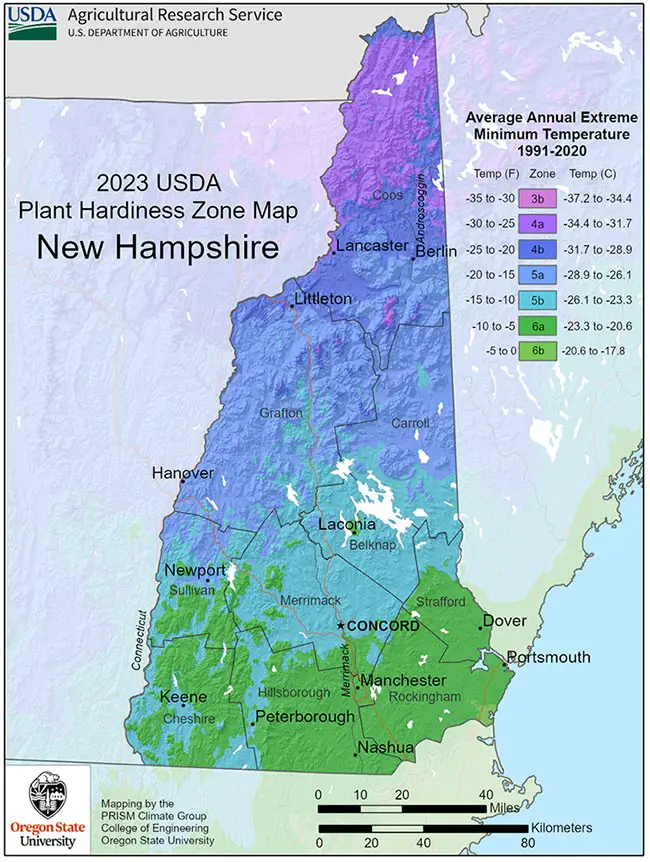
Extreme temperatures in New Hampshire have reached as high as 106°F (41°C) during the hottest times and as low as –46°F (–43°C) during the coldest periods. The state occasionally experiences the effects of hurricanes, tropical storms, and blizzards. New Hampshire’s USDA hardiness zones range from 3b to 6a.

Growing Palm Trees in New Hampshire

While some palm trees can tolerate short periods of cold down to -10°F, they need to be fully mature to withstand such conditions. In reality, New Hampshire’s climate is too cold for palm trees to thrive.

However, you can cultivate palm trees indoors in containers and bring them outside during the summer months, allowing you to enjoy palm trees in your garden for a few months each year. Some great indoor palms are:

More Palm Trees»

Major Cities in New Hampshire

Manchester – Hardiness Zone 4b
Nashua – Hardiness Zone 5a
Similar Posts

  • Mississippi Palm Trees

    You can successfully cultivate palm trees in the warmer regions of Mississippi, which enjoys a humid subtropical climate characterized by short, mild winters and long, scorching summers. The summertime here can be quite humid, with an average July temperature soaring to about 95°F (approximately 35°C). On the other hand, January ushers in milder weather, with…

  • Georgia State Palm Trees

    While Georgia may not boast the same tropical warmth as Florida, it’s still a place where cold-hardy palm trees can thrive. The state enjoys a humid subtropical climate characterized by hot summers and mild winters, thanks to the influence of the nearby Atlantic Ocean. In January, you can expect an average temperature of 39°F (4°C),…

  • Oregon Palm Trees

    Oregon offers some warm areas where cold-hardy palm trees can thrive. The state is divided into several regions with climates ranging from temperate to drier semi-arid, and its weather is significantly influenced by the Pacific Ocean. Average January temperatures span from 25°F (–4°C) to 45°F (7°C), while average July temperatures vary from 5°F (18°C) to…

  • Minnesota Palm Trees

    Minnesota’s climate isn’t exactly palm tree-friendly. The state boasts a continental climate, featuring warm summers and frigid winters. Summers vary from hot and humid to warm and less muggy, with average July temperatures ranging between 61°F (16°C) and 76°F (24°C), depending on your location. Meanwhile, January brings chilly temperatures that hover between 3°F(−16°C) and 18°F…

  • Utah Palm Trees

    In Utah, you can successfully cultivate cold-hardy palm trees that exhibit remarkable durability and adaptability to desert conditions. Utah boasts a semi-arid to arid climate, characterized by pleasant weather featuring warm summers and mild winters. Approximately 33% of the state comprises true desert areas, where winter temperatures typically average below 32°F during the winter months….

  • Arkansas Palm Trees

    Despite Arkansas’ reputation for extreme weather, it is possible to cultivate palm trees in the state. Arkansas boasts a subtropical climate characterized by hot, humid summers and relatively colder, drier winters. Summers see average temperatures in the low 90s, accompanied by high humidity levels, while winters tend to linger in the low 50s. Throughout a…