Maryland Palm Trees

While Maryland experiences cool winters overall, there are specific regions where palm trees can thrive. Maryland boasts a humid subtropical climate influenced by the Atlantic Ocean, featuring hot and humid summers with an average July temperature of 77°F (25°C) and cool winters with an average January temperature of 33°F (1°C).

The annual snowfall varies significantly, ranging from 9 to 100 inches (23-250 cm) depending on the location within the state.

Notably, Maryland has experienced extreme temperature fluctuations, with the highest recorded temperature reaching 109°F (43°C) and the lowest plummeting to -40°F (-40°C).

Additionally, the state encounters approximately 30 to 40 thunderstorms and sees an average of 6 tornadoes annually.

Growing Palm Trees in Maryland

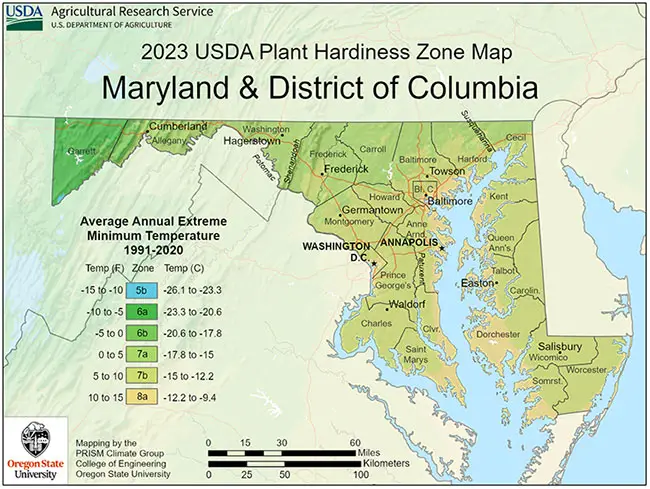
Maryland’s USDA hardiness zones span from 5b to 8a, providing suitable conditions for the cultivation of palm trees. For successful palm growth in the warmer parts of Maryland, specifically in zones 7 and 8, it’s essential to select palm tree varieties known for their cold-hardiness and adaptability to varying soil conditions.

To protect them during the winter months, it’s crucial to provide adequate cold protection measures. Here are some of the palms that could grow in Maryland:

More Palm Trees»

Major Cities in Maryland

Baltimore – Hardiness Zone 7a
Columbia – Hardiness Zone 6b
Salisbury – Hardiness Zone 7a
Silver Spring – Hardiness Zone 6b
Similar Posts

  • Minnesota Palm Trees

    Minnesota’s climate isn’t exactly palm tree-friendly. The state boasts a continental climate, featuring warm summers and frigid winters. Summers vary from hot and humid to warm and less muggy, with average July temperatures ranging between 61°F (16°C) and 76°F (24°C), depending on your location. Meanwhile, January brings chilly temperatures that hover between 3°F(−16°C) and 18°F…

  • Colorado Palm Trees

    Colorado presents a significant challenge for anyone thinking of cultivating palm trees, given its frigid climate and diverse geography. The state comprises mountains, foothills, high plains, and desert lands, resulting in a semi-arid to alpine climate that varies with elevation. Extreme weather is par for the course in Colorado. Winters are bitterly cold and snow-laden,…

  • West Virginia Palm Trees

    Growing palm trees in West Virginia can be quite challenging unless you create a special environment. West Virginia has a mix of climates, including a humid continental climate and some parts with a humid subtropical climate. Summers here are humid and warm to hot, with July temperatures typically ranging from 67 °F (19 °C) to…

  • Michigan Palm Trees

    Cultivating palm trees in Michigan can be a daunting challenge due to the state’s predominantly cold climate. Michigan is characterized by a continental climate, which translates to scorching summers and extremely cold winters. In July, the average temperatures typically span the range of 64 to 72°F (18 to 22°C). However, come January, the average temperatures…

  • Delaware Palm Trees

    Delaware might not be the ideal locale for growing palm trees, primarily due to its temperate and humid climate with a limited number of sunny days. The state experiences a climate that’s a mix of humid subtropical and continental, heavily influenced by the Atlantic Ocean. Southern Delaware enjoys a milder climate compared to the northern…

  • Iowa Palm Trees

    Iowa presents a challenging environment for palm tree cultivation, as it is generally too cold for these tropical plants. Even the most cold-hardy palm varieties can only endure the colder temperatures found in zone 7 and higher. Iowa’s climate is characterized as humid continental, featuring wet springs, hot summers, and cold winters, with significant annual…