West Virginia Palm Trees

Growing palm trees in West Virginia can be quite challenging unless you create a special environment. West Virginia has a mix of climates, including a humid continental climate and some parts with a humid subtropical climate.

Summers here are humid and warm to hot, with July temperatures typically ranging from 67 °F (19 °C) to 76 °F (24 °C), while winters are cool to cold, with average January temperatures ranging from 26 °F (−4 °C) to 41 °F (5 °C).

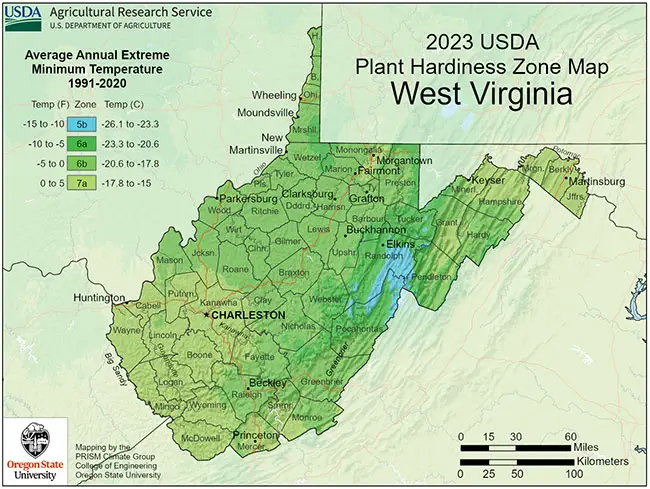
Dense fogs are a common occurrence in the state, and West Virginia usually receives about 34 inches (86 cm) of snow each year. The USDA hardiness zones in West Virginia vary from 5a to 7a.

Growing Palm Trees in West Virginia

Only cold hardy palm trees will grow in West Virginia. Providing a cover and creating a microclimate can dramatically increase the list of palms that will grow in your area.

More Palm Trees»

Major Cities in West Virginia

Beckley – Hardiness Zone 5b
Charleston – Hardiness Zone 6b
Fairmont – Hardiness Zone 5b
Parkersburg – Hardiness Zone 6a
Wheeling – Hardiness Zone 6b
Similar Posts

  • Kentucky Palm Trees

    Growing palm trees in the state of Kentucky can be quite challenging due to its climate conditions. Kentucky features a humid subtropical climate, characterized by warm and humid summers, with an average maximum July temperature of 87°F (30°C). Winters in Kentucky are moderately cold, with an average temperature in January hovering around 40°F (4°C). The…

  • Georgia State Palm Trees

    While Georgia may not boast the same tropical warmth as Florida, it’s still a place where cold-hardy palm trees can thrive. The state enjoys a humid subtropical climate characterized by hot summers and mild winters, thanks to the influence of the nearby Atlantic Ocean. In January, you can expect an average temperature of 39°F (4°C),…

  • Washington Palm Trees

    You can indeed grow palm trees in the warm parts of Washington state. Washington has a mild climate, and it’s divided into two main regions: the western part, which has an oceanic climate, and the eastern part, which leans more towards a continental climate. The Cascade Mountains split the state. In the western region, the…

  • New Hampshire Palm Trees

    New Hampshire is not a suitable place for palm trees due to its cold climate. The state experiences a humid continental climate characterized by cold and snowy winters, as well as warm and humid summers. In the southeastern part of the state, the influence of the Atlantic Ocean is felt. July sees average temperatures around…

  • Kansas Palm Trees

    Kansas is not conducive to palm tree cultivation due to its predominantly cold climate. The state of Kansas experiences three distinct climate types: humid subtropical, humid continental, and semi-arid steppe. Depending on the region, summers can be either hot and humid or hot and dry, with July maximum temperatures ranging from 91°F (32°C) to 93°F…