Wyoming Palm Trees

Wyoming’s climate is too cold to support the growth of palm trees. The state experiences a semi-arid and continental climate, primarily influenced by factors such as its high altitude, northern latitude, and local topography.

These elements collectively contribute to temperature fluctuations, precipitation levels, airflow patterns, and humidity levels. Overall, Wyoming is characterized by its dry and windy weather conditions.

During the summer months, specifically in July, temperatures in Wyoming typically range from 55°F (13°C) to 82°F (28°C). However, come January, the state experiences much colder weather, with temperatures spanning from 15°F (–9°C) to 38°F (3°C).

Winters in Wyoming tend to be lengthy and marked by strong winds. On the other hand, summers are generally pleasant, with temperatures in the 70s and 80s.

Notably, the evenings witness a rapid drop in temperature. Wyoming also experiences some tornado and thunderstorm activity.

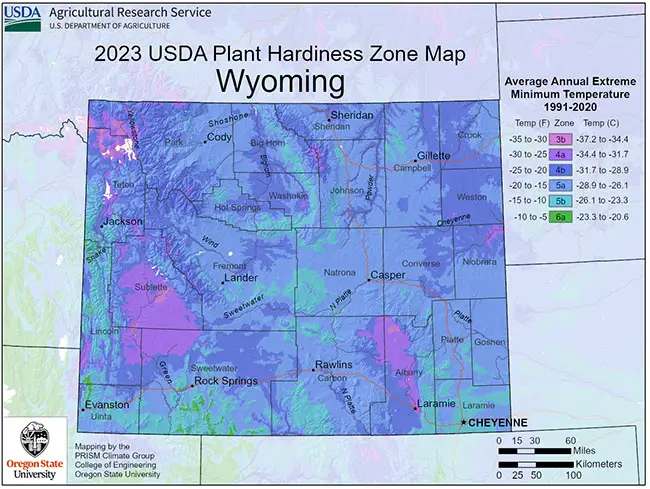
In terms of USDA hardiness zones, Wyoming covers a range from 3a to 6a. These zones reflect the state’s capacity to support various plant species based on their cold tolerance, and they underscore the challenging environment for tropical and subtropical plants like palm trees in the region.

Growing Palm Trees in Wyoming

Wyoming is too cold to grow palm trees outdoors, but you can grow them indoors and take them outside when the weather is warm. Some great indoor palms are:

More Palm Trees»

Major Cities in Wyoming

  • Casper – Hardiness Zone 4b
  • Cheyenne – Hardiness Zone 5a

Similar Posts

  • Tennessee Palm Trees

    Growing palm trees in Tennessee poses a considerable challenge due to its cold winters. The state’s climate varies, encompassing a humid subtropical climate in some areas and a humid continental climate in others. Summers tend to be hot and humid, with average July temperatures hovering around 90°F (32°C). Winters, while generally mild to cool, feature…

  • 10 Palm Trees That Grow in Virginia (with Pictures)

    While Virginia may not be the ideal location for palm tree cultivation, there are several cold-hardy palm varieties that can thrive in the state’s unique climate. Virginia experiences a mild, humid coastal climate characterized by hot, humid summers and cold, snowy winters. July typically sees an average temperature of 78°F (26°C), while January’s average temperature…

  • Washington Palm Trees

    You can indeed grow palm trees in the warm parts of Washington state. Washington has a mild climate, and it’s divided into two main regions: the western part, which has an oceanic climate, and the eastern part, which leans more towards a continental climate. The Cascade Mountains split the state. In the western region, the…

  • New Hampshire Palm Trees

    New Hampshire is not a suitable place for palm trees due to its cold climate. The state experiences a humid continental climate characterized by cold and snowy winters, as well as warm and humid summers. In the southeastern part of the state, the influence of the Atlantic Ocean is felt. July sees average temperatures around…

  • Nevada Palm Trees

    You can successfully cultivate palm trees in the warm regions of Nevada, which boasts a desert and semiarid climate characterized by a wide range of daily temperatures. Generally, the weather in Nevada is dry and sunny, with the southern region experiencing long, hot summers and short, mild winters. Moving westward, you’ll find short, hot summers…

  • Indiana Palm Trees

    Indiana’s climate isn’t favorable to palm tree cultivation. The state experiences a humid continental climate, characterized by chilly winters and warm summers. In January, temperatures typically range from 17°F (–8°C) to 35°F (2°C), while July sees averages ranging from 63°F (17°C) to 88°F (31°C). The USDA hardiness zones in Indiana span from 5b to 6b….