
New Jersey Palm Trees
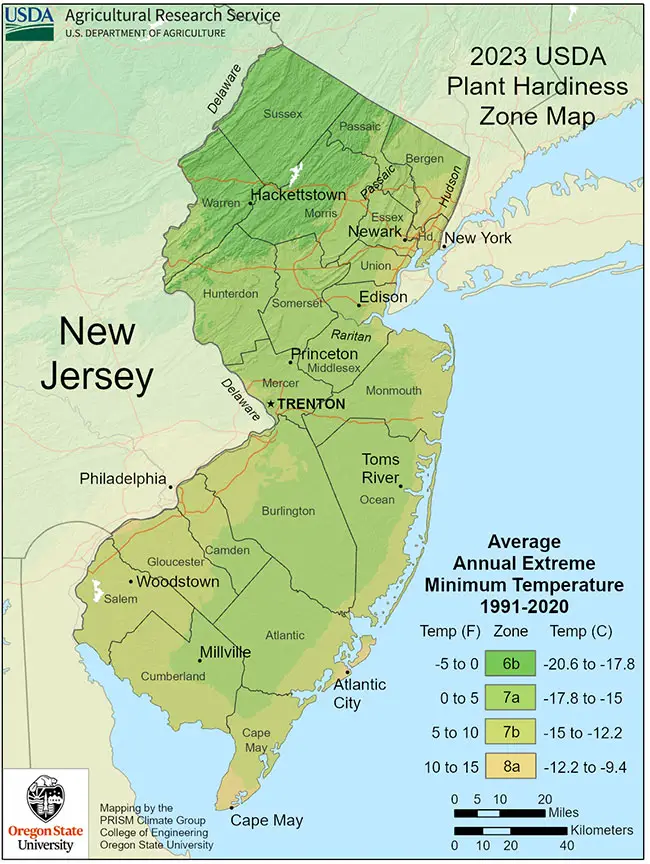
Growing palm trees in New Jersey presents significant challenges. The state’s climate includes several regions, with variations from humid mesothermal to a humid continental climate.
Summers tend to be hot and humid, featuring average July temperatures around 75°F (24°C). Winters, on the other hand, are cold, with average January temperatures of 31°F (–1°C). Snowfall accumulates annually within the range of 10-50 inches (0.25-1.3 meters).
New Jersey experiences approximately 25 to 30 thunderstorms each year, with occasional blizzards in the winter. While hurricanes, tropical storms, tornadoes, and earthquakes are rare, they do occur.
The warmest temperature ever recorded in the state soared to 110°F (43°C), while the lowest dropped to a bone-chilling –34°F (–37°C). New Jersey’s USDA hardiness zones span from 6a to 7b.
Growing Palm Trees in New Jersey
New Jersey is predominantly a cold state, with only a few small areas falling within zone 7b. Attempting to cultivate palm trees outside of zone 7 poses a significant risk, as they are unlikely to survive in the harsher conditions. Some cold hardy palms that can be grown in Zone 7 are:
- European Fan Palm Tree – Zones 7b-11 (5 to 10 F)
- Pindo Palm Tree – Zones 7b-11 (5 to 10 F)
- Sago Palm Tree – Zones 7b-11 (5 to 10 F)
- Saw Palmetto Palm Tree – Zones 7a-11 (0 to 5 F)
- Windmill Palm Tree – Zones 7b-11 (5 to 10 F)
More Palm Trees»
Major Cities in New Jersey
Brick – Hardiness Zone 6b
Camden – Hardiness Zone 7a
Edison – Hardiness Zone 6b
Elizabeth – Hardiness Zone 7a
Jersey City – Hardiness Zone 7a
Newark – Hardiness Zone 7a
Paterson – Hardiness Zone 6b
Trenton – Hardiness Zone 6b
Hi. I live in NY. Can a Christmas Palm kept indoors survive during our harsh winters? Thanks in advance.
hi,im thinking about cocanut palms for my back yard in ringwood nj what do you think
Both Point Pleasant NJ and LBI have beach side bars that have live palms growing on the beach and nearby. Just saying. I’m looking to make it happen… grow some kind of palm in my yard up at the Poconos, even it it’ll take extra care in fall and over the winter to protect it. What the hell is a Tiki bar without palm trees!? I just want a few. I plan to incorporate some tropical looking plants like day lilies and Rose of Sharon with smaller potted ones I’ll bring home and keep in the house over winter, and of course maybe some good old artificial ones.
Hmm? 👍👌👏🌴🌺🌾🌵
I’ve determined it would be easier to move to San Diego than try to bring it here but oh well… Whatcha gonna do? It’s way cheaper here. 😋