
Missouri Palm Trees
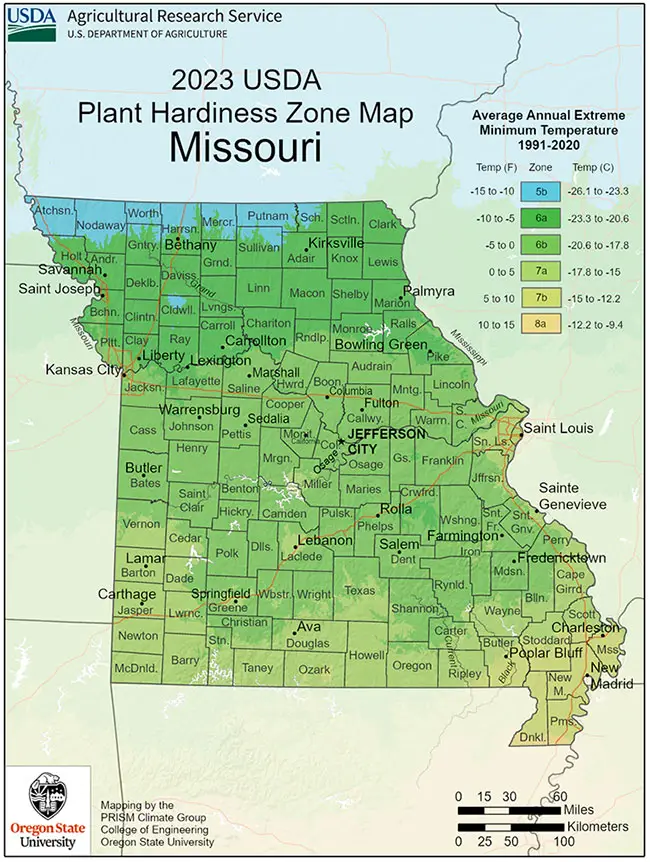
Cultivating palm trees in Missouri is quite the challenge, primarily because of the harsh winter conditions that prevail in the state.
Missouri’s climate can be described as humid continental, marked by lengthy, scorching summers and cool to downright cold winters. In July, the average temperature hovers around 79°F (26°C), but come January, it drops to an average of 26°F (–3°C).
The temperature extremes in Missouri tell quite a story, with the highest ever recorded at a blistering 118°F (48°C) and the lowest plummeting to a bone-chilling –40°F (–40°C).
Snowfall in the state varies depending on the location, averaging between 10 inches (25 cm) and 20 inches (51 cm) annually. Tornadoes are also a part of Missouri’s weather landscape, with around 35 touching down each year. In terms of USDA hardiness zones, Missouri spans from 5b to 7b.
Growing Palm Trees in Missouri
Given its rather chilly climate, Missouri isn’t the most favorable place for palm trees. Your best shot at palm tree growth would be in zone 7, particularly near Cape Girardeau city.
However, it’s essential to keep in mind that all it takes is one exceptionally cold day to wipe out your entire palm tree population. If you see that cold weather is coming, provide your trees with protection.
- European Fan Palm Tree – Zones 7b-11 (5 to 10 F)
- Pindo Palm Tree – Zones 7b-11 (5 to 10 F)
- Sago Palm Tree – Zones 7b-11 (5 to 10 F)
- Saw Palmetto Palm Tree – Zones 7a-11 (0 to 5 F)
- Windmill Palm Tree – Zones 7b-11 (5 to 10 F)
More Palm Trees»
Major Cities in Missouri
Cape Girardeau – Hardiness Zone 6a
Columbia – Hardiness Zone 6a
Independence – Hardiness Zone 6b
Joplin – Hardiness Zone 6b
Kansas City – Hardiness Zone 6b
O’Fallon – Hardiness Zone 6a
Saint Charles – Hardiness Zone 5b
Saint Joseph – Hardiness Zone 5b
Saint Louis – Hardiness Zone 6b
Saint Peters – Hardiness Zone 6a
Springfield – Hardiness Zone 6a
Try Sabal Minor ‘McCurtain’, Sabal Minor ‘Arkansas’, and/or Rhapidophyllum Hystrix in the bootheel cities. If you grow them close to the south side of your house where they are protected from cold winds, you have a good shot at success. If you have to plant them in the yard, plant them under a Texas Live Oak or an evergreen tree of some sort for some level of protection. Cities like Caruthersville, Steele, and Cooter would be good spots for an attempt.
My family and I have visited Florida a few times, and the only thing my mom loves more than the beaches there are the palm trees. Every time we go, she always wants one, but we live in Missouri. Unfortunately the only thing I really understood about this article is that it’s impossible to grow them unless you line near CG, and unfortunately, we don’t. We’re an hour west of St. Louis, so that doesn’t exactly work out. Is it possible for us to grow a palm tree? Are there such things as mini palm trees that could be kept indoors?
Thanks, Megan
Megan,
All of the types I mentioned above are relatively small. You could growth email outside and just cover them if you get a deep freeze. If you want to grow them in pots inside, you could grow pygmy date palms. They are pretty compact and grow well in pots.
Hello Megan,
You could try rhapidophyllum hystrix (Needle Palm) or sabal minor ‘McCurtain’, ‘Arkansas’, or the varieties from northern Alabama or North Carolina. Plant them on the south side of your house and cover them during the really cold winter days.
Indoors, phoenix roebelenii stays relatively small. There are many others that grow well in pots. There is even an entire forum for this here: http://www.palmtalk.org/forum/index.php?/forum/45-palms-in-pots/