
Georgia State Palm Trees
While Georgia may not boast the same tropical warmth as Florida, it’s still a place where cold-hardy palm trees can thrive. The state enjoys a humid subtropical climate characterized by hot summers and mild winters, thanks to the influence of the nearby Atlantic Ocean.
In January, you can expect an average temperature of 39°F (4°C), while July brings warmer weather with an average of 78°F (26°C). Temperature extremes have reached 112°F (44°C) at the high end and a nippy −17°F (−27°C) at the low end.
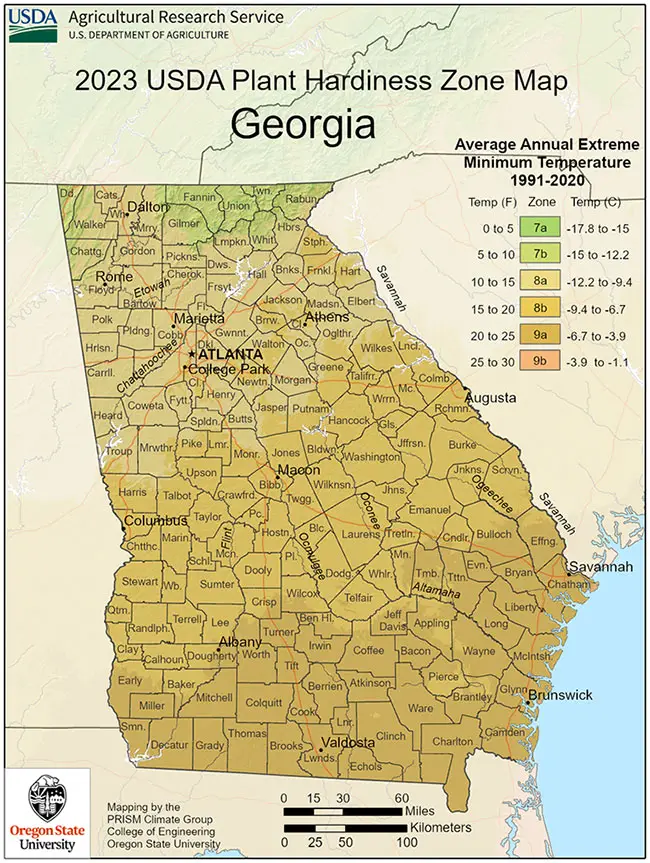
Winters in Georgia tend to be dry, while summers are hot and humid, occasionally punctuated by thunderstorms. The state also faces the occasional threat of tornadoes and tropical storms, especially in areas along the Florida border. Georgia’s USDA hardiness zones span from 6a to 9a.
Growing Palm Trees in Georgia
Given the limited presence of zone 9 areas in the state, it’s wise to opt for cold-hardy palm trees capable of withstanding the chillier conditions found in zones 7-8.
While there are only a few palm species that can brave the even colder zone 6 and below, the Saw Palmetto Palm stands out as a native of Georgia.
This resilient palm can endure temperatures as low as 0°F. If you reside in zone 7a or higher, you can successfully cultivate the Saw Palmetto Palm in your area.
- California Fan Palm Tree – Zones 8b -11 (15 to 20 F)
- Canary Island Date Palm Tree – Zones 8b -11 (15 to 20 F)
- Chinese Fan Palm Tree – Zones 8a – 11 (10 to 15 F)
- True Date Palm Tree – Zones 8b -11 (15 to 20 F)
- European Fan Palm Tree – Zones 7b – 11 (5 to 10 F)
- Mexican Fan Palm Tree – Zones 8b -11 (15 to 20 F)
- Queen Palm Tree – Zones 8b -11 (15 to 20 F)
- Saw Palmetto Palm Tree – Zones 7a -11 (0 to 5 F)
- Silver Saw Palmetto Palm Tree – Zones 7a – 11 (0 to 5 F)
More Palm Trees»
Major Cities in Georgia
Albany – Hardiness Zone 8a
Atlanta – Hardiness Zone 7b
Augusta – Hardiness Zone 8a
Columbus – Hardiness Zone 8a
Lawrenceville – Hardiness Zone 7a
Macon – Hardiness Zone 8a
Marietta – Hardiness Zone 7a
Savannah – Hardiness Zone 8b
I was wondering how much a palm tree was and where y’all were located I live close to Savannah
I am looking for pindo palms. I need two small trees about three feet tall and three about five to six feet tall.. I want something that is slow growing but will at least grow six inches to a foot a year.I was told the Pindo palm is a full leaf tree and that it is quite attractive.
I want to grow some palm trees near my pool. The carpentaria is the fastest growing I’ve read but is it a good tree for Augusta, Ga? If not, what is the best palm and how fast will it grow? Thanks!