
Colorado Palm Trees
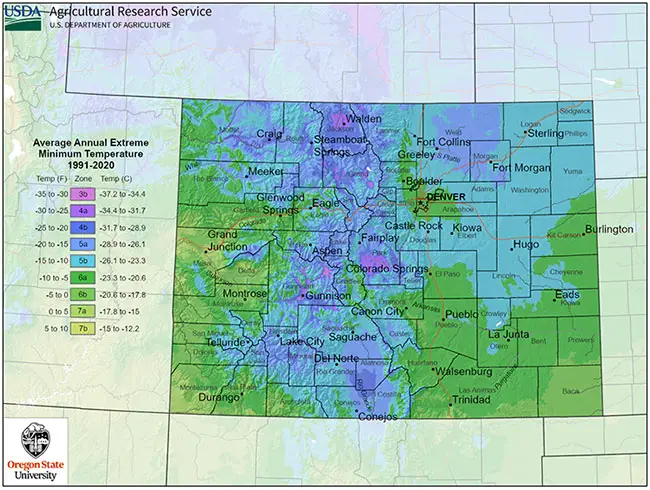
Colorado presents a significant challenge for anyone thinking of cultivating palm trees, given its frigid climate and diverse geography. The state comprises mountains, foothills, high plains, and desert lands, resulting in a semi-arid to alpine climate that varies with elevation.
Extreme weather is par for the course in Colorado. Winters are bitterly cold and snow-laden, with average temperatures ranging from 16°F to 43°F (–9°C to 6°C) in January.
Summers offer some relief but remain relatively cool and dry, featuring average temperatures between 59°F and 88°F (15°C to 31°C) in July. Colorado’s temperature extremes have reached a scorching 118°F (48°C) and a bone-chilling −60°F (−51°C).
Colorado experiences a variety of weather phenomena, including hailstorms, thunderstorms, and tornadoes. The USDA Hardiness zones in the state encompass a wide range, from 3a to 7a.
Growing Palm Trees in Colorado
It’s important to note that Colorado ranks among the coldest states in the U.S., and its extreme weather conditions make it highly unlikely for even the hardiest palm trees to thrive. The Needle Palm stands as one of the most cold-resistant palm varieties, capable of tolerating temperatures down to -15°F.
If you’re determined to give palm growing a shot, creating a microclimate with sufficiently warm temperatures is essential. However, it’s vital to maintain realistic expectations about the challenges posed by Colorado’s harsh climate.
More Palm Trees»
Major Cities in Colorado
Arvada – Hardiness Zone 6a
Aurora – Hardiness Zone 5b
Boulder – Hardiness Zone 5b
Colorado Springs – Hardiness Zone 5b
Denver – Hardiness Zone 6a
Fort Collins – Hardiness Zone 4b
Grand Junction – Hardiness Zone 5b
Lakewood – Hardiness Zone 6a
Littleton – Hardiness Zone 5b
Pueblo – Hardiness Zone 5b
So it says that needle palm trees can grow from zones 5 b – 11. Here in Pueblo, we are 5 b. Does that mean we would stand a chance?
Thank you!
The front Range of Colorado is actually quite warm and sunny. In fact, the major cities along the front Range are among the sunniest cities in the United States- I think every one of them is in the top 10 or top 20. Temperatures here are typically much higher than quoted here in this article. It is warm enough that some years we have kept our outdoor swimming pool open as long as 8 to 9 months out of the year. We do have the possibility of getting snow in the city, but snowfall amounts are usually minimal and the sun usually melts it within a day or so. The rare actual snowstorm is seen maybe once every 10 years if that. In the last five years, I think each year we’ve gotten one to two snowstorms in the city that each amounted to less than a couple inches of snow that was gone within a day. During the winter, temperatures in the 60s are very common and in the summer, expect daytime temperatures in the 80s to 90s. It very very rarely approaches freezing even during the night in the dead of winter. We have had very little problems growing tropicals here outside.