
Tennessee Palm Trees
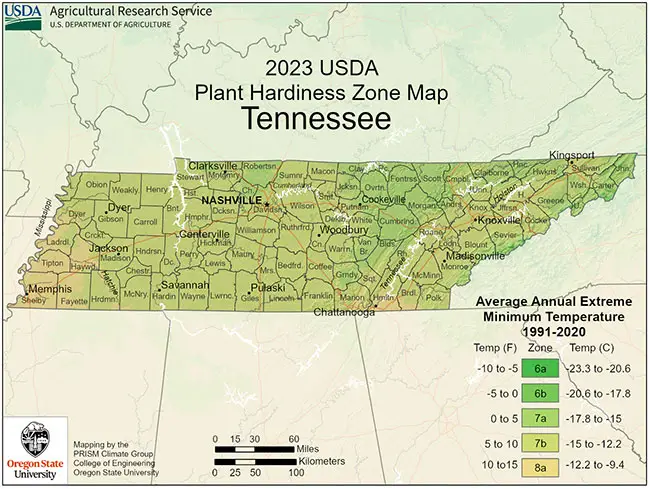
Growing palm trees in Tennessee poses a considerable challenge due to its cold winters. The state’s climate varies, encompassing a humid subtropical climate in some areas and a humid continental climate in others.
Summers tend to be hot and humid, with average July temperatures hovering around 90°F (32°C). Winters, while generally mild to cool, feature average January temperatures of approximately 40°F (4°C).
Tennessee experiences around 50 days of thunderstorms each year, occasionally witnessing tornadoes, remnants of tropical cyclones, and ice storms.
Temperature extremes have been observed in Tennessee, with the highest recorded temperature soaring to 113°F (45°C) and the lowest plummeting to a bone-chilling -32°F (–36°C). The state’s USDA hardiness zones encompass a range from 5b to 8a.
Growing Palm Trees in Tennessee
Growing palm trees in Tennessee is very challenging. If you want to grow palm trees, you need to live in zone 7. If you live in colder areas, you will need to create a microclimate that has at least temperatures of zone 7.
Here are some very cold hardy palm trees that can tolerate cold temperatures done to 5F and colder:
- Needle Palm Tree – Zones 5b-11 (-15 to -10F)
- European Fan Palm Tree – Zones 7b-11 (5 to 10 F)
- Pindo Palm Tree – Zones 7b-11 (5 to 10 F)
- Sago Palm Tree – Zones 7b-11 (5 to 10 F)
- Saw Palmetto Palm Tree – Zones 7a-11 (0 to 5 F)
- Windmill Palm Tree – Zones 7b-11 (5 to 10 F)
More Palm Trees»
Major Cities in Tennessee
Chattanooga – Hardiness Zone 7a
Clarksville – Hardiness Zone 6a
Jackson – Hardiness Zone 6a
Johnson City – Hardiness Zone 6b
Knoxville – Hardiness Zone 7a
Memphis – Hardiness Zone 7b
Nashville – Hardiness Zone 6b


‘Not sure what your hardiness zone is? Enter your zip code into the box below and click “GO” button.”
I do not see the box where I need to enter my zip code. Where is it?
my zip code is 37144, looks like zone 7B