
Louisiana Palm Trees
There are numerous palm tree varieties that thrive in the state of Louisiana, thanks to its accommodating climate. Louisiana boasts a humid subtropical climate heavily influenced by the Gulf of Mexico.
Summers are characterized by scorching heat and high humidity, with an average July temperature hovering around 82°F (28°C). Winters, on the other hand, are relatively mild, with an average January temperature of approximately 52°F (11°C).
Notably, Louisiana has witnessed extreme temperature swings, with the highest recorded temperature soaring to a scorching 114°F (46°C) and the lowest dropping to a chilly –16°F (–27°C).
The state occasionally experiences hurricanes and tropical storms, particularly during the summer months, while snowfall is a rarity.
Growing Palm Trees in Louisiana
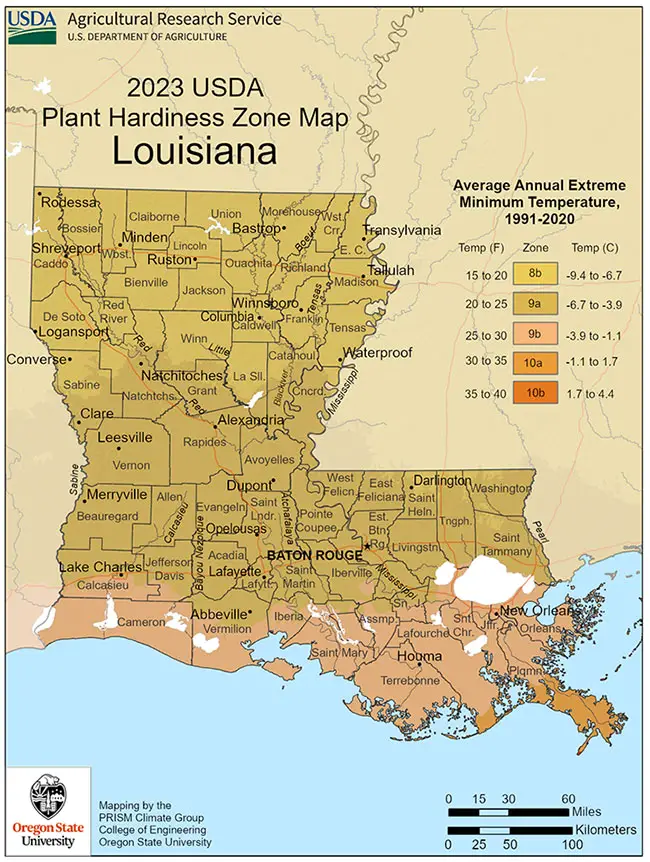
Louisiana’s USDA hardiness zones span from 8a to 10a, making it an ideal location for palm tree cultivation, especially within the zone 9. Here are some palms that can grow in Louisiana:
- Bismarck Palm Tree – Zones 8b – 11 (15 to 20F)
- Caranday Palm Tree – Zones 9a – 11 (20 to 25F)
- Mexican Fan Palm Tree – Zones 8b – 11 (15 to 20F)
- Triangle Palm Tree – Zones 10a – 11 (30 to 35F)
- Pindo Palm Tree – Zones 7b-11 (5 to 10 F)
More Palm Trees»
Major Cities in Louisiana
Alexandria – Hardiness Zone 8b
Baton Rouge – Hardiness Zone 8b
Lafayette – Hardiness Zone 9a
Lake Charles – Hardiness Zone 9a
Metairie – Hardiness Zone 9a
Monroe – Hardiness Zone 8a
New Orleans – Hardiness Zone 9a
Shreveport – Hardiness Zone 8a
Hi Katrin,
I live in zone 9a (New Orleans, La) and I’m considering planting a Christmas palm. I understand a Christmas palm prefers a 10a zone climate. My question is if I were to follow each of your steps in protecting the palm from cold weather, do you think I would be successful in keeping the palm alive through each winter or is the added protection not enough to protect from the rare freezes seen in New Orleans?
Thanks!
Blake