Illinois Palm Trees

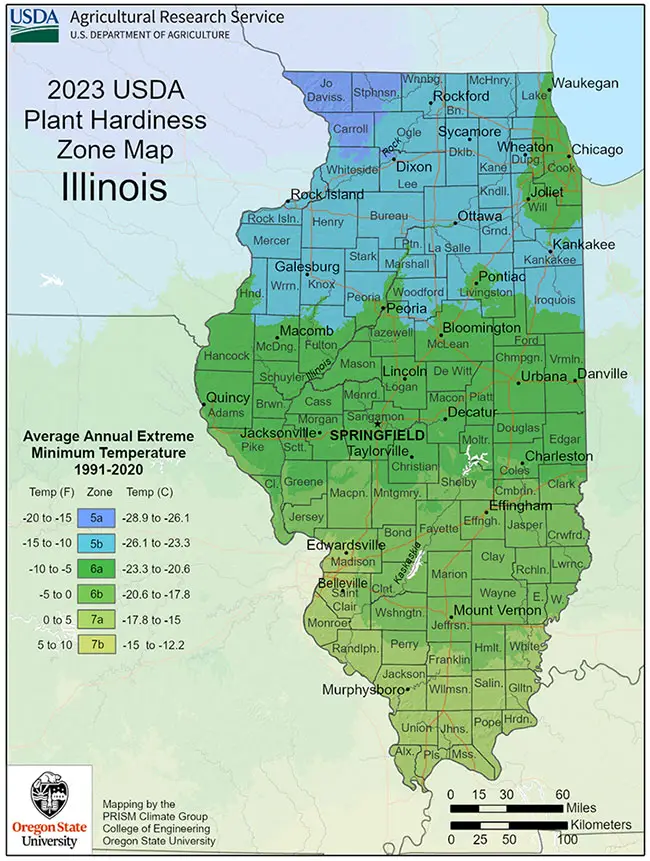
You can give palm tree growing a shot in zone 7a, especially near the Kentucky border where the climate leans closer to humid subtropical. Illinois, however, is more on the temperate side.

Summers here get hot and humid, with average temperatures ranging from 70°F (21°C) to 77°F (25°C), while winters can be cool to downright cold, averaging between 22°F (–6°C) and 37°F (3°C). Illinois USDA hardiness zones cover the range from 5a to 7a.

The temperature extremes in Illinois have hit 117°F (47°C) at the high end and a bone-chilling –36°F (–37.8°C) at the low end. Throughout the year, expect your fair share of thunderstorms and around 37 inches of snowfall. And yes, the state does face the threat of tornadoes.

Growing Palm Trees in Illinois

But let’s be clear, Illinois isn’t exactly a paradise for palm trees. Your best bet would be to give it a shot in the zone 7 area near Cape Girardeau City.

However, bear in mind that just one extremely cold day can spell doom for your palms. If you sense a cold snap approaching, make sure to provide your trees with some much-needed protection.

More Palm Trees»

Major Cities in Illinois

Arlington Heights – Hardiness Zone 5a
Aurora – Hardiness Zone 5a
Chicago – Hardiness Zone 5b
Decatur – Hardiness Zone 5a
Elgin – Hardiness Zone 5a
Naperville – Hardiness Zone 5a
Peoria – Hardiness Zone 5a
Quincy – Hardiness Zone 5b
Rockford – Hardiness Zone 5a
Springfield – Hardiness Zone 5b
Similar Posts

  • Massachusetts Palm Trees

    Cultivating palm trees in Massachusetts is a challenging endeavor, primarily due to the state’s limited zone 7 area and the daunting winter storms it often faces. Massachusetts boasts a continental climate marked by cold, snowy winters and warm, humid summers. In January, average temperatures dip to around 22°F (–6°C), while July ushers in a milder…

  • Louisiana Palm Trees

    There are numerous palm tree varieties that thrive in the state of Louisiana, thanks to its accommodating climate. Louisiana boasts a humid subtropical climate heavily influenced by the Gulf of Mexico. Summers are characterized by scorching heat and high humidity, with an average July temperature hovering around 82°F (28°C). Winters, on the other hand, are…

  • Montana Palm Trees

    Montana, one of the states notorious for its frigid climate, isn’t exactly the ideal locale for palm tree cultivation. This vast state can be categorized into two distinct climatic regions: semi-arid and continental. Its average January temperature hovers at 27°F (–2°C), while July brings an average temperature of 85°F (29°C). Winters here can be exceptionally…

  • Washington DC Palm Trees

    Washington DC boasts a humid subtropical climate with distinctive seasonal variations. Winters are relatively cool, featuring an average temperature of 38°F (3.3°C) in January, while summers can be hot and humid, with an average temperature of 79.2°F (26.2°C). Winter in the district typically witnesses an annual snowfall averaging 14.7 inches (37cm), while summers bring frequent…

  • Florida Palm Trees

    Palm trees thrive in the warm, humid embrace of Florida’s climate. The state’s weather ranges from tropical to subtropical, featuring mild winters and scorching summers. In the northern part, temperatures typically hover between 65°F to 70°F (18°C to 21°C), while in the south, it’s a balmy 74°F to 77°F (23°C to 25°C). Despite the annual…

  • North Dakota Palm Trees

    North Dakota’s climate is simply too cold to support the growth of palm trees. The state experiences a continental climate characterized by hot summers and cold winters. In January, the average temperature drops to a chilly 7°F (-14°C), while July brings an average temperature of 69°F (21°C). North Dakota is known for its extreme weather,…