Montana Palm Trees

Montana, one of the states notorious for its frigid climate, isn’t exactly the ideal locale for palm tree cultivation. This vast state can be categorized into two distinct climatic regions: semi-arid and continental. Its average January temperature hovers at 27°F (–2°C), while July brings an average temperature of 85°F (29°C).

Winters here can be exceptionally cold, with most major cities receiving an annual snowfall of 30 to 50 inches (760 to 1,300 mm).

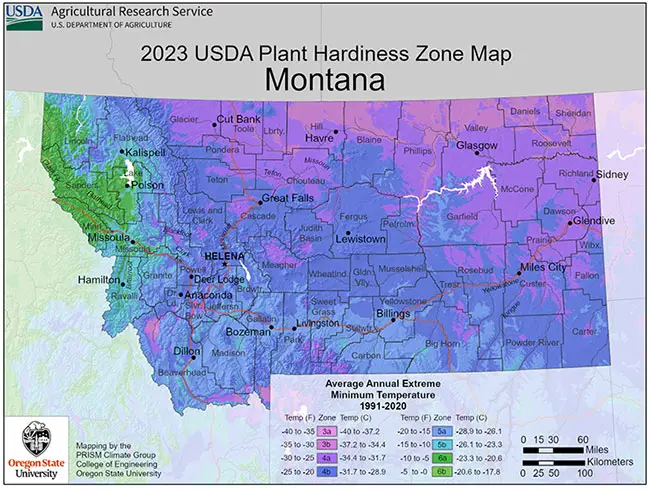
The temperature extremes in Montana have reached a sweltering 117°F (47°C) at its warmest and a bone-chilling –70°F (–57°C) at its coldest. Montana’s USDA hardiness zones span from 3a to 6a.

Growing Palm Trees in Montana

Taking a closer look at the hardiness zone map, it’s evident that zone 6a is quite elusive in Montana. Most of the state is actually in zones 3b and 4a, which are way too chilly for palm trees to thrive.

So, if you really want those palm tree vibes in your yard, the smart move is to grow them indoors in containers and let them soak up the sunshine outside during the warmer summer months.

That way, you can have your garden graced by palm trees for a few months each year. Some great indoor palms are:

More Palm Trees»

Major Cities in Montana

Billings – Hardiness Zone 4a
Butte – Hardiness Zone 3a
Glendive – Hardiness Zone 3a
Great Falls – Hardiness Zone 4a
Helena – Hardiness Zone 3b
Missoula – Hardiness Zone 5b
Similar Posts

  • Rhode Island Palm Trees

    Rhode Island’s climate is not conducive to palm trees, as it experiences cold temperatures throughout the year. The state features a humid continental climate characterized by chilly winters and brief, rainy summers. Summers are relatively warm, with average July temperatures around 73°F (23°C), while winters are cold, with an average January temperature of 28°F (–2°C)….

  • Nebraska Palm Trees

    Nebraska, being a predominantly cold state, is not favorable to the cultivation of palm trees. It is geographically divided into two distinct climatic regions: the eastern half of the state experiences a humid continental climate, while the western half is characterized by a semi-arid climate. Summers here tend to be hot, with an average July…

  • Utah Palm Trees

    In Utah, you can successfully cultivate cold-hardy palm trees that exhibit remarkable durability and adaptability to desert conditions. Utah boasts a semi-arid to arid climate, characterized by pleasant weather featuring warm summers and mild winters. Approximately 33% of the state comprises true desert areas, where winter temperatures typically average below 32°F during the winter months….

  • New Hampshire Palm Trees

    New Hampshire is not a suitable place for palm trees due to its cold climate. The state experiences a humid continental climate characterized by cold and snowy winters, as well as warm and humid summers. In the southeastern part of the state, the influence of the Atlantic Ocean is felt. July sees average temperatures around…

  • Michigan Palm Trees

    Cultivating palm trees in Michigan can be a daunting challenge due to the state’s predominantly cold climate. Michigan is characterized by a continental climate, which translates to scorching summers and extremely cold winters. In July, the average temperatures typically span the range of 64 to 72°F (18 to 22°C). However, come January, the average temperatures…

  • California Palm Trees

    Growing palm trees in California is a breeze, especially if you’re situated in the warmer regions. California’s climate spans the gamut from arid to subarctic, featuring dry summers and rainy winters. In July, temperatures across the state average between 75°F (24°C) and 93°F (34°C), varying by location. Come January, you can expect average temperatures to…