Minnesota Palm Trees

Minnesota’s climate isn’t exactly palm tree-friendly. The state boasts a continental climate, featuring warm summers and frigid winters.

Summers vary from hot and humid to warm and less muggy, with average July temperatures ranging between 61°F (16°C) and 76°F (24°C), depending on your location.

Meanwhile, January brings chilly temperatures that hover between 3°F(−16°C) and 18°F (−8°C). The temperature extremes in Minnesota have soared to a scorching 114°F (46°C) and plunged to a bone-chilling –60°F (–51°C).

Minnesota experiences its fair share of thunderstorms, clocking in around 30–40 thunderstorm days per year, along with approximately 24 tornadoes.

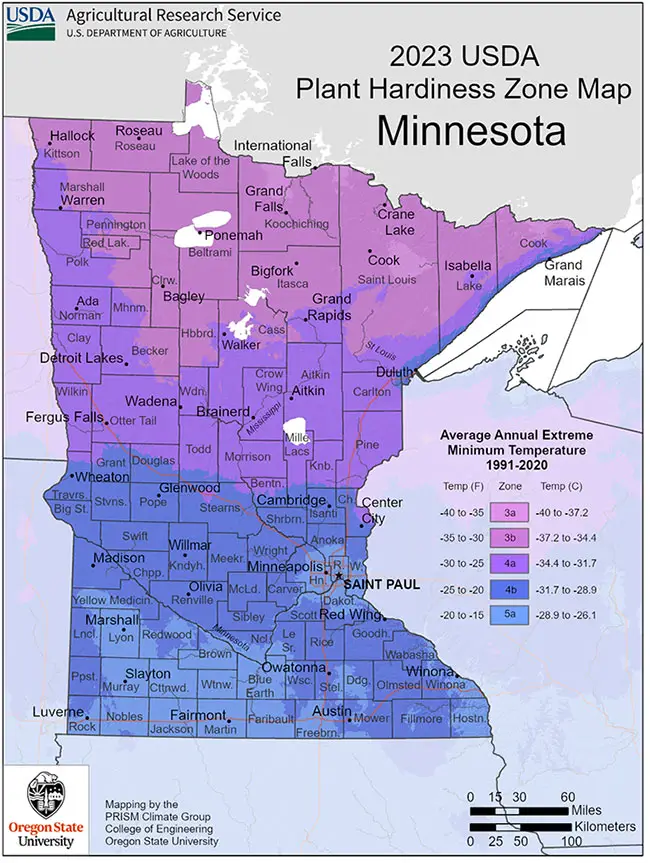
The state is no stranger to heavy snowfall either, with accumulations spanning from 30 inches (76 cm) to a whopping 70 inches (178 cm). To top it off, Minnesota contends with blizzards, on average, about twice each winter. The USDA hardiness zones in Minnesota range from 3a to 5a.

Growing Palm Trees in Minnesota

Given these harsh conditions, growing palm trees outdoors in Minnesota can be a challenge. A more practical approach would be to cultivate palm trees indoors within containers and move them outdoors during the summer months.

This way, you can enjoy palm trees in your garden for a few months each year, without subjecting them to Minnesota’s extreme cold. Some great indoor palms are:

More Palm Trees»

Major Cities in Minnesota

Bloomington – Hardiness Zone 4a
Duluth – Hardiness Zone 4a
Mankato – Hardiness Zone 4b
Minneapolis – Hardiness Zone 4a
Rochester – Hardiness Zone 3b
Saint Cloud – Hardiness Zone 3b
Saint Paul – Hardiness Zone 4b
Similar Posts

  • Florida Palm Trees

    Palm trees thrive in the warm, humid embrace of Florida’s climate. The state’s weather ranges from tropical to subtropical, featuring mild winters and scorching summers. In the northern part, temperatures typically hover between 65°F to 70°F (18°C to 21°C), while in the south, it’s a balmy 74°F to 77°F (23°C to 25°C). Despite the annual…

  • Kansas Palm Trees

    Kansas is not conducive to palm tree cultivation due to its predominantly cold climate. The state of Kansas experiences three distinct climate types: humid subtropical, humid continental, and semi-arid steppe. Depending on the region, summers can be either hot and humid or hot and dry, with July maximum temperatures ranging from 91°F (32°C) to 93°F…

  • Wisconsin Palm Trees

    Growing palm trees in Wisconsin is impractical due to the state’s cold climate. Wisconsin experiences a continental climate characterized by warm summers and extremely cold winters. The presence of Lake Michigan and Superior also influences its weather patterns. During the summer months, particularly in July, Wisconsin witnesses average temperatures ranging from 68°F (20°C) to 80°F…

  • Kentucky Palm Trees

    Growing palm trees in the state of Kentucky can be quite challenging due to its climate conditions. Kentucky features a humid subtropical climate, characterized by warm and humid summers, with an average maximum July temperature of 87°F (30°C). Winters in Kentucky are moderately cold, with an average temperature in January hovering around 40°F (4°C). The…

  • Delaware Palm Trees

    Delaware might not be the ideal locale for growing palm trees, primarily due to its temperate and humid climate with a limited number of sunny days. The state experiences a climate that’s a mix of humid subtropical and continental, heavily influenced by the Atlantic Ocean. Southern Delaware enjoys a milder climate compared to the northern…

  • Colorado Palm Trees

    Colorado presents a significant challenge for anyone thinking of cultivating palm trees, given its frigid climate and diverse geography. The state comprises mountains, foothills, high plains, and desert lands, resulting in a semi-arid to alpine climate that varies with elevation. Extreme weather is par for the course in Colorado. Winters are bitterly cold and snow-laden,…