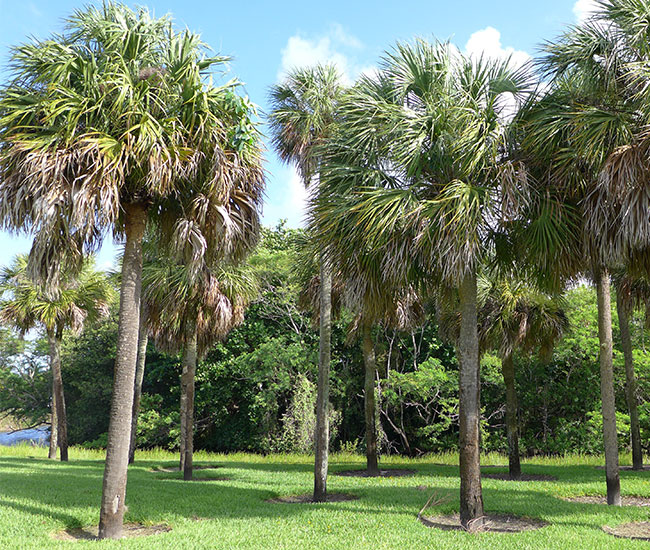
Wyoming is too cold to grow palm trees. Wyoming has a semi-arid and continental climate that is mostly determined by its altitude, latitude, and local topography. When combined together, these elements have a lot to do with temperature variations, precipitation, airflow patterns and humidity. Generally, Wyoming has a dry windy weather.
The summer temperatures in July range between 55°F (13°C) to 82°F (28°C). In January, temperatures range from 15°F (–9°C) to 38°F (3°C). The winters are long with strong winds. Summers in Wyoming are usually pleasant with temperatures in 70s and 80s. After the sundown, the air cools down very quickly. It does have some tornado and thunderstorm activity. Wyoming USDA hardiness zones range from 2a to 5b.
Wyoming USDA Zones

Growing Palm Trees in Wyoming
Wyoming is too cold to grow palm trees outdoors, but you can grow them indoors and take them outside when the weather is warm. Some great indoor palms are:
Major Cities in Wyoming
- Casper – Hardiness Zone 4b
- Cheyenne – Hardiness Zone 5a
Find your hardiness zone
Filed under: Palm Tree Types by
Susan Brian
No Comments »
Wisconsin is too cold to grow palm trees. Wisconsin has a continental climate with warm summers and very cold winters. It is influenced by Lakes Michigan and Superior. The average temperature in July ranges from 68°F (20°C) to 80°F (27°C). In January the average temperature ranges from 8°F (–13°C) to 26°F (–3°C) depending on the location.
In the upper northeast and north-central the freeze-free season is only about 80 days per year. In the north-central it is about 180 days. Wisconsin USDA hardiness zones range from 2b to 5a.
Wisconsin USDA Zones

Growing Palm Trees in Wisconsin
This state is too cold for growing palm trees outdoors, but you can grow them indoors and take them outside during warm months. Some great indoor palms are:
Major Cities in Wisconsin
Eau Claire – Hardiness Zone 4a
Green Bay – Hardiness Zone 4b
Kenosha – Hardiness Zone 5a
Madison – Hardiness Zone 4b
Milwaukee – Hardiness Zone 5a
Racine – Hardiness Zone 5a
Wausau – Hardiness Zone 4a
Find your hardiness zone
Filed under: Palm Tree Types by
Susan Brian
No Comments »
It is very difficult to grow palm trees in West Virginia without creating a microclimate. West Virginia has is a humid continental climate with some areas located in a humid subtropical climate. The summers are humid, warm to hot with average July temperatures range from 67 °F (19 °C) to 76 °F (24 °C) while winters are cool to cold with average January temperatures range from 26 °F (−4 °C) to 41 °F (5 °C).
Dense fogs are very common for the state. On average West Virginia gets about 34 inches (86 cm) of snow annually. West Virginia USDA hardiness zones range from 5a to 7a.
West Virginia USDA Zones

Growing Palm Trees in West Virginia
Only cold hardy palm trees will grow in West Virginia. Providing a cover and creating a microclimate can dramatically increase the list of palms that will grow in your area.
Major Cities in West Virginia
Beckley – Hardiness Zone 5b
Charleston – Hardiness Zone 6b
Fairmont – Hardiness Zone 5b
Parkersburg – Hardiness Zone 6a
Wheeling – Hardiness Zone 6b
Find your hardiness zone
Filed under: Palm Tree Types by
Susan Brian
No Comments »
You can grow palm trees in the warm areas of Washington state. Washington has a mild climate with western region located in an oceanic climate and eastern region located more in a continental climate. The state is divided by the Cascade Mountains. Average January temperatures in western region range between 20°F (–7°C) and 48°F (9°C) while average July temperatures range from 44°F (7°C) to 80°F (27°C). In the eastern region average January temperatures range from 8°F to 40°F (–13°C to 4°C) while July temperatures range from 48°F to 92°F (9°C to 33°C).
The state gets on average between 11.4 in to 49.4 in (29 cm to 125.5 cm) of snow annually. October through March the state experiences heavy rains. The warmest temperature ever recorded was 118°F (48°C) and the lowest was –48°F (–44°C). Washington USDA hardiness zones range from 4a to 9a.
Washington USDA Zones

Growing Palm Trees in Washington
There are a lot of cold hardy palms that can grow in the zones 8 and 9 of Washington state. Here are palm trees that can grow in Washington:
Major Cities in Washington
Bellevue – Hardiness Zone 9a
Seattle – Hardiness Zone 9a
Spokane – Hardiness Zone 5a
Tacoma – Hardiness Zone 9a
Vancouver – Hardiness Zone 7b
Yakima – Hardiness Zone 5b
Find your hardiness zone
Filed under: Palm Tree Types by
Susan Brian
No Comments »
There are some cold hardy palm trees that will grow in Virginia. Virginia has a mild humid coastal climate with hot humid summers and cold snowy winters. The average July temperature is about 78°F (26°C) while the average January temperature is around 36°F (2°C). Virginia gets threatened from tropical cyclones, hurricanes, tornadoes, and winter storms. Annual snowfall ranges from 8-15 in (20-38 cm).
The warmest temperature ever recorded was 110°F (43°C) and the lowest was –30°F (–34°C). Virginia USDA hardiness zones average from 5b to 8b.
Virginia USDA Zones

Growing Palm Trees in Virginia
You can grow palm trees in the warmer areas starting with zone 7b and higher. You’ll need to buy cold hardy palms that can tolerate cold down to 5F. Here are some palm trees that can grow in Virginia:
Major Cities in Virginia
Alexandria – Hardiness Zone 7b
Arlington – Hardiness Zone 7a
Chesapeake – Hardiness Zone 8a
Hampton – Hardiness Zone 7b
Harrisonburg – Hardiness Zone 6a
Midlothian – Hardiness Zone 7a
Newport News – Hardiness Zone 7b
Norfolk – Hardiness Zone 8a
Portsmouth – Hardiness Zone 8a
Richmond – Hardiness Zone 7a
Roanoke – Hardiness Zone 7a
Stafford – Hardiness Zone 6b
Virginia Beach – Hardiness Zone 8a
Find your hardiness zone
Filed under: Palm Tree Types by
Susan Brian
No Comments »